
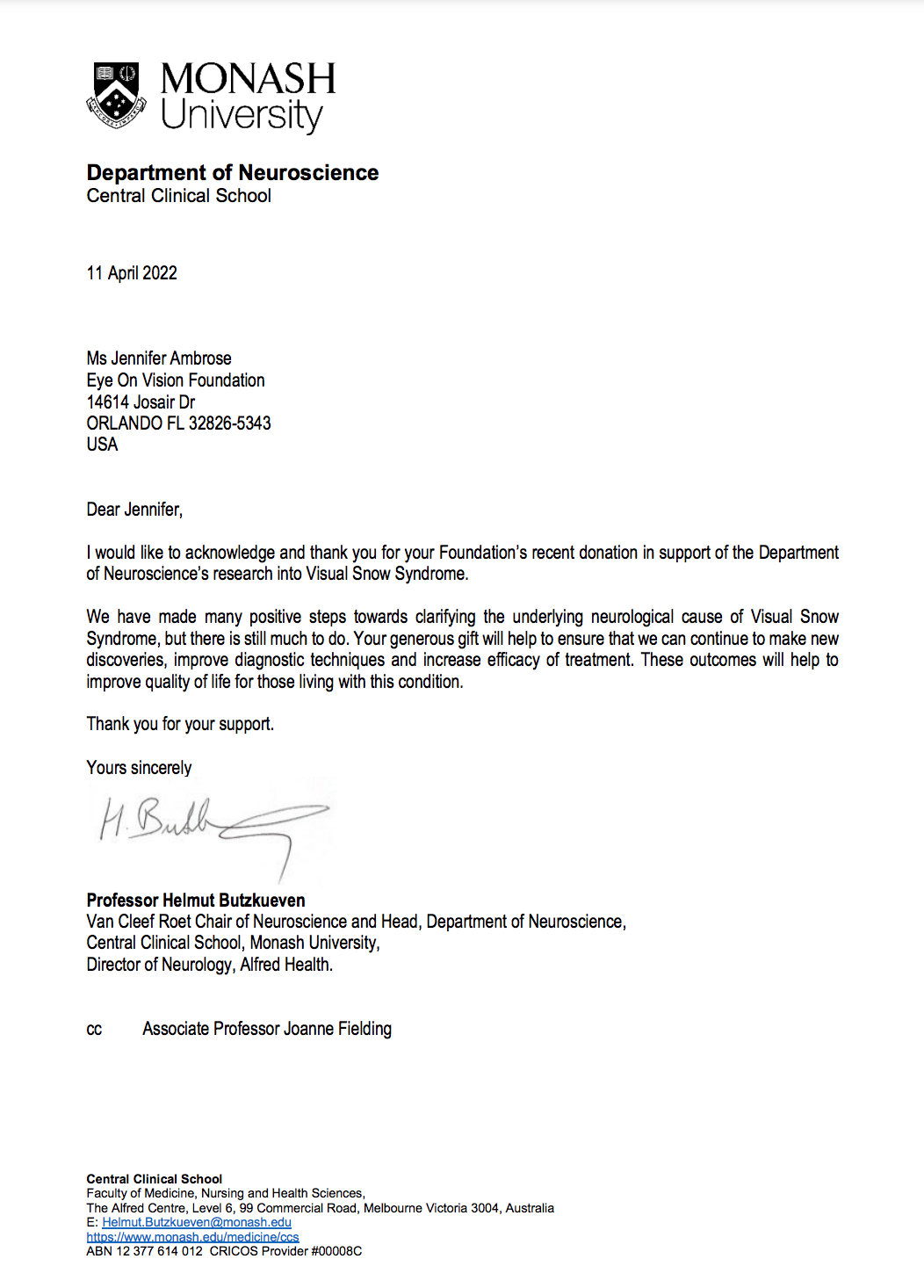
 I am absolutely thrilled to announce that with a global effort funds have been raised for VSS research to move forward at Monash University! More details will be coming, but I wanted to let all of our supporters and donors know that we did it! Big changes are ahead in the lives of Visual Snow sufferers!
Patient advocate/consumer Patricia and Associate Professor Joanne Fielding talk about respectively the experience of living with Visual Snow Syndrome, and the challenges of research. 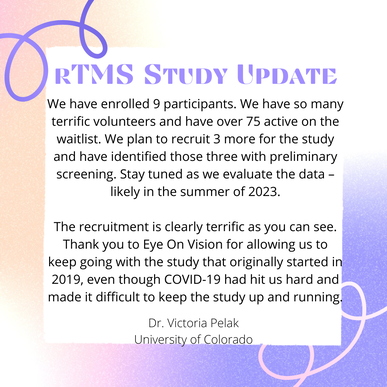 Hello. We have enrolled 9 participants. We have so many terrific volunteers and have over 75 active on the waitlist. We plan to recruit 3 more for the study and have identified those three with preliminary screening. Stay tuned as we evaluate the data – likely in the summer of 2023.
The recruitment is clearly terrific as you can see. Thank you to Eye On Vision for allowing us to keep going with the study that originally started in 2019, even though COVID-19 had hit us hard and made it difficult to keep the study up and running. Published: August 21, 2019
Updated: September 23, 2021 Migraine aura without headache, sometimes referred to as “silent migraine,” does not feature any head pain. By Dr. Jennifer Robblee Headache can be a common migraine symptom. But not all forms of migraine come with headache. “Migraine aura without headache”—previously known as “acephalgic migraine” and sometimes called “silent migraine”—is when someone has a migraine aura without any head pain. Despite a lack of head pain, migraine aura without headache is still disabling for those who live with it. It also has its own set of considerations for diagnosis and treatment. The following is a breakdown of the basics of this form of migraine. To read full article, please click here Distinct Patterns of P1 and C2 VEP Potentiation and Attenuation in Visual Snow: A Case Report1/24/2022
Alison M. Harris Department of Psychological Science, Claremont McKenna College, Claremont, CA, United States Visual snow syndrome, characterized by persistent flickering dots throughout the visual field, has been hypothesized to arise from abnormal neuronal responsiveness in visual processing regions. Previous research has reported a lack of typical VEP habituation to repeated stimulus presentation in patients with visual snow. Yet these studies generally used pattern-reversal paradigms, which are suboptimal for measuring cortical responses to the onset of foveal stimulation. Instead, these responses are better indexed by the C2, a pattern-onset VEP peaking 100–120 ms after stimulus onset. In this case study, we analyzed the C2 and its adaptation profile in data previously collected from a single patient with visual snow using a “double-pulse” presentation paradigm. In controls, shorter intervals between stimulus pairs were associated with greater attenuation of the C2 VEP, with recovery from adaptation at longer stimulus onset asynchronies (SOAs). However, the visual snow patient showed the opposite pattern, with reduced C2 amplitude at longer SOAs despite distinct C2 peaks at the shortest SOAs. These results stand in contrast not only to the pattern of C2 VEP attenuation in controls, but also to a lack of adaptation previously reported for the pattern-onset P1 VEP in this patient. Exploratory source localization using equivalent current dipole fitting further suggested that P1 and C2 VEPs in the visual snow patient arose from distinct sources in extrastriate visual cortex. While preliminary, these results support differential patterns of VEP attenuation and potentiation within the same individual, potentially pointing toward multiple mechanisms of abnormal neuronal responsiveness in visual snow syndrome. To read the full article please click here or download PDF below. 
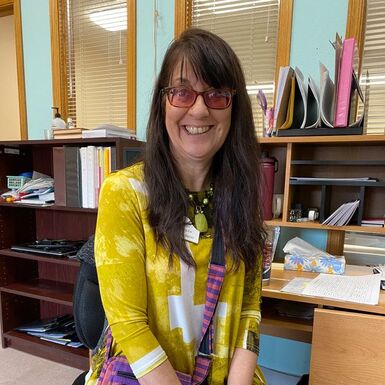 My name is Cindy Miller and I have had Visual Snow Syndrome for most of my life. In fact, I can’t seem to remember when it started. I have suspected that I had this syndrome many years ago as I have seen various posts on the symptoms. It seems recently that VSS has come to light and its about time. I have been to so many eye docs and doctors who have tried to treat the symptoms separately. I have not run across any specialist that is aware of VSS or even remotely interested in learning more about VSS.
I wear Irlen filtered glasses ( I am a certified screener) and the lenses have been a big coping mechanism for me to cope with life without chronic headaches. Otherwise the world, spins and swirls and reading is very difficult for me. I was not aware of the other various symptoms of VSS such as tinnitus, lack of night vision and depersonalization. and anxiety. I have always suffered from great anxiety and feel that my brain is on constant overload. Additionally, I am blind in my left eye and the VSS in my right eye makes everything much harder. My hope is that someday I will be able to receive the right treatment for VSS and maybe encounter the chance to see things clearly. Thank you Eye On Vision for your research and awareness! |
UpdateRecent update on research. Archives
November 2023
Categories |
||||
 RSS Feed